Controlled Access, Accountability, and Documented Security for Regulated and Policy-Driven Environments
Access control is not just about securing doors.
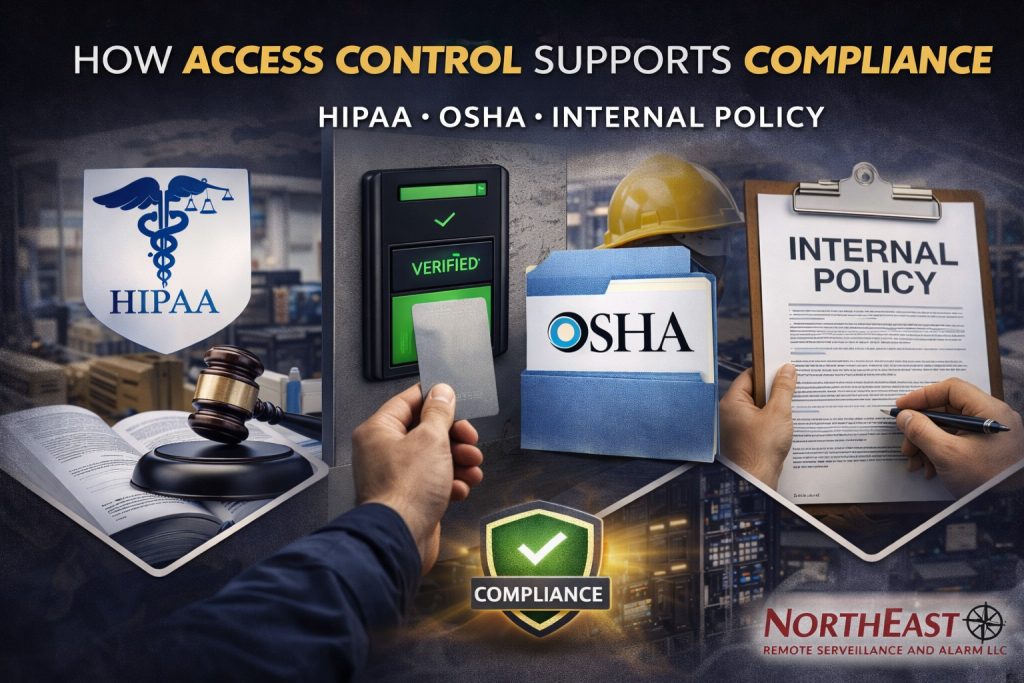
For many businesses, it plays a direct role in compliance, accountability, and internal policy enforcement. Whether the requirement comes from healthcare regulations, workplace safety standards, or internal company rules, access control helps ensure that only authorized individuals can enter specific areas—and that access is documented.
Northeast Remote Surveillance and Alarm, LLC designs access control systems that help organizations support compliance through controlled entry, credential management, and verifiable activity tracking. For broader entry management, see [Access Control System]. For business-level deployment, see [Commercial Access Control].
Why Compliance Matters in Physical Security
Many organizations must control access to specific areas due to:
- sensitive information
- regulated materials
- safety risks
- operational controls
- internal policies
Without a structured system, businesses often rely on keys, informal processes, or inconsistent enforcement—none of which provide reliable documentation or control.
Access control replaces that with defined permissions and recorded activity.
How Access Control Supports HIPAA Compliance
Healthcare environments require strict control over access to patient information, medical areas, and sensitive records.
Access control helps support HIPAA-related requirements by:
- restricting access to authorized personnel only
- limiting entry to records rooms, IT systems, and treatment areas
- supporting role-based permissions for staff
- documenting access activity for accountability
- reducing unauthorized access to protected health information (PHI)
Access logs provide a record of who entered specific areas and when, which supports internal review and compliance processes.
How Access Control Supports OSHA and Workplace Safety
OSHA focuses on workplace safety and hazard control. In many environments, that includes limiting access to dangerous or restricted areas.
Access control helps support OSHA-related safety practices by:
- restricting entry to hazardous areas
- controlling access to equipment or mechanical rooms
- limiting unauthorized movement in industrial spaces
- supporting safety procedures with controlled entry points
- reducing risk of injury from unauthorized access
By controlling who can enter specific areas, businesses can better enforce safety protocols and reduce liability.
Supporting Internal Policy and Business Rules
Not all compliance requirements come from external regulations. Many businesses have internal policies that define who should have access to certain areas.
Access control supports internal policy enforcement by:
- assigning access by role or department
- controlling entry to sensitive rooms or operations
- limiting access based on schedules or shifts
- managing employee, vendor, and contractor permissions
- enforcing restricted-area policies consistently
This helps businesses move from informal rules to enforceable, trackable systems.
Audit Trails and Accountability
One of the most important compliance benefits of access control is documentation.
A properly configured system records:
- who accessed a door
- when access occurred
- whether access was granted or denied
- which credential was used
- activity tied to specific areas
These audit trails help support:
- internal investigations
- compliance reviews
- incident documentation
- policy enforcement
- liability protection
Instead of relying on assumptions, businesses have a verifiable record of access activity.
Reducing Risk Through Controlled Access
Compliance is not only about documentation. It is also about reducing risk.
Access control helps reduce:
- unauthorized entry
- accidental access to restricted areas
- internal misuse of sensitive spaces
- policy violations
- gaps in accountability
By controlling access at the door level, businesses create a more structured and predictable environment.
Integration Strengthens Compliance
Access control becomes more effective when integrated with other security systems.
Combined with video surveillance and alarm systems, businesses can:
- verify access events visually
- review incidents faster
- confirm activity in restricted areas
- document events more clearly
- strengthen overall compliance support
For integrated security planning, see [Video Surveillance and Access Control Unified Security Systems].
Scalable Compliance for Growing Organizations
As businesses grow, compliance requirements often become more complex.
Access control systems can scale to support:
- additional doors and restricted areas
- more users and credential types
- multiple departments or buildings
- updated policies and procedures
- expanded reporting and audit needs
This allows organizations to maintain compliance without rebuilding their security system.
Why Businesses Choose Northeast Remote Surveillance and Alarm, LLC
Businesses choose Northeast Remote Surveillance and Alarm, LLC because access control is designed to support real operational and compliance needs.
That includes:
- role-based access planning
- clean credential management
- reliable audit trails
- scalable system design
- integration with broader security systems
- long-term support and service
We design systems that help businesses maintain control, improve accountability, and support compliance requirements without overcomplicating daily operations.
Schedule a Compliance-Focused Access Control Review
If your business needs better control over restricted areas, improved documentation, or stronger support for compliance and internal policies, Northeast Remote Surveillance and Alarm, LLC can help.
Call 1-888-344-3846 or visit [Contact Us] to get started.
Frequently Asked Questions
How does access control help with compliance?
Access control restricts entry to authorized users and creates a record of access activity, which supports compliance, accountability, and internal policy enforcement.
Is access control required for HIPAA compliance?
HIPAA does not require a specific system, but it requires controlled access to sensitive information. Access control systems help meet that requirement.
Can access control improve workplace safety?
Yes. By limiting access to hazardous or restricted areas, access control helps support workplace safety practices and OSHA-related standards.
What is an audit trail in access control?
An audit trail is a recorded log of access events, showing who entered, when they entered, and what areas were accessed.
Can access control support internal business policies?
Yes. Access control allows businesses to enforce internal rules by controlling who can access specific areas and when.