Commercial & Industrial Warehouse Security for Distribution, Logistics, and High-Value Storage Environments
Warehouse security systems need to do more than watch a building after hours.
A warehouse has moving inventory, truck traffic, employee entrances, dock activity, restricted areas, after-hours access, yard movement, and operational risk that changes throughout the day. A real warehouse security system has to support security, accountability, safety, and day-to-day operations without creating friction that slows the facility down.
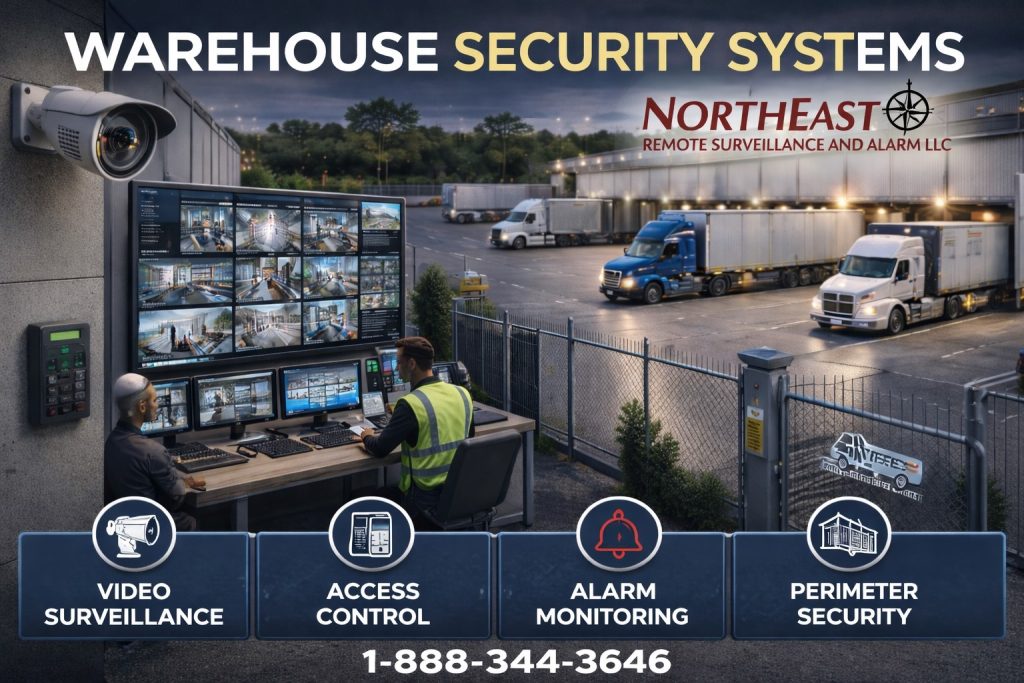
Northeast Remote Surveillance and Alarm, LLC designs and installs warehouse security systems for commercial and industrial environments that need stronger visibility, tighter access control, better alarm coverage, and cleaner integration across the property. For broader entry-control planning, see [Commercial Access Control]. For a wider view of connected door and credential management, see [Access Control System].
What a Warehouse Security System Needs to Protect
Warehouses are not secured by one device or one camera. They need layered protection around the parts of the property that actually create exposure.
That often includes:
- employee entrances
- loading docks
- shipping and receiving offices
- inventory storage areas
- cage rooms and secured storage
- IT and telecom rooms
- maintenance and utility spaces
- trailer and yard access points
- side and rear approaches
- gates and perimeter entry points
- after-hours parking and vehicle areas
A properly designed warehouse security system helps control movement through the facility while giving management better visibility into what is happening and where.
Built for Real Warehouse and Logistics Operations
Warehouse environments create different security demands than ordinary office buildings. Many facilities deal with shift changes, vendor access, seasonal labor, contractor traffic, high employee turnover, valuable inventory, and multiple points of entry spread across a larger footprint.
That is why warehouse security has to be designed around actual workflow.
A good system should help a facility:
- reduce unauthorized entry
- improve accountability around inventory and restricted areas
- document dock and door activity
- support internal investigations
- monitor after-hours movement
- tighten employee-only and contractor-only areas
- scale as the operation expands
Video Surveillance for Warehouses
Video surveillance is one of the most important parts of a warehouse security system because it gives the facility visibility across the areas where loss, liability, safety incidents, and unauthorized activity are most likely to happen.
Warehouse video coverage may include:
- dock lanes and loading areas
- shipping and receiving zones
- aisles and staging areas
- pallet and inventory storage
- employee entrances and exits
- parking and yard areas
- side and rear building approaches
- gate entries and perimeter lines
Depending on the environment, systems may use fixed cameras, multi-sensor cameras, PTZ cameras, low-light cameras, thermal cameras, license plate recognition, and AI-based alerting. For monitoring-focused support, see [Video Monitoring].
Access Control for Warehouse Entry Points
Warehouses often need stronger control over who can enter, which doors they can use, and what areas they can access. Keys alone do not provide enough control for fast-moving environments with multiple employees, rotating staffing, delivery activity, and restricted support spaces.
Warehouse access control may be used for:
- employee entrances
- office-to-warehouse transitions
- shipping offices
- inventory cages
- tool and maintenance rooms
- IT and server rooms
- management offices
- gate and yard access
That can include cards, fobs, mobile credentials, keypad entry, role-based permissions, shift-based schedules, and centralized audit trails. For deeper credential and door-control planning, see [Access Control Credentials] and [Commercial Door Access Control Systems].
Alarm Protection for Warehouse Security
Alarm systems add another layer of protection by helping detect intrusion, unauthorized entry, perimeter breaches, and after-hours activity that may not be caught by access control alone.
Warehouse alarm systems may include:
- intrusion detection
- door and window contacts
- motion detection
- glass break protection
- beam or perimeter devices
- environmental alerts
- after-hours breach notifications
- integrated dispatch or response workflows
When designed properly, alarms help support faster response and better documentation around unusual activity. For alarm-specific service detail, see [Commercial Alarm Systems].
Dock, Yard, and Perimeter Security
Many warehouse losses and security problems do not start at the front door. They start at the edge of the property, around loading docks, side approaches, service lanes, gates, trailer lines, and after-hours vehicle movement.
That is why warehouse security systems often need stronger perimeter awareness and yard visibility.
Perimeter and dock security planning may include:
- gate access control
- trailer and vehicle monitoring
- license plate recognition
- dock-view cameras
- rear and side building coverage
- monitored service entrances
- perimeter alarms or beam detection
- scheduled access for vendors and contractors
The goal is to reduce blind spots while still allowing the site to operate efficiently.
Integrated Security Works Better in Warehouses
Warehouse security becomes more effective when access control, cameras, alarms, and monitoring are designed to work together instead of as separate systems.
An integrated system can help the facility:
- verify badge activity with video
- review forced-door or propped-door incidents faster
- track after-hours entry against recorded footage
- support internal theft investigations
- document safety and liability events
- monitor multiple zones from one platform
For integrated planning, see [Video Surveillance and Access Control Unified Security Systems].
Internal Theft Prevention and Accountability
Warehouse security is not only about outside threats. Many facilities also need stronger accountability around internal movement, employee-only areas, inventory handling, shipping functions, and sensitive storage locations.
A stronger warehouse security system helps reduce internal risk through:
- better visibility at docks and staging areas
- cleaner access logs
- controlled access to restricted rooms
- video verification tied to entry events
- better documentation for investigations
- reduced unmanaged movement through sensitive zones
That does not mean overcomplicating the building. It means creating more control where the risk actually exists.
Scalable Security for Growing Operations
Warehouse operations often grow over time. More users are added. More doors need control. Additional cameras are required. New docks come online. Yard activity changes. Buildings are expanded. Multiple warehouses may need to be managed together.
That is why warehouse security systems should be designed for scale.
A strong deployment should support:
- added cameras
- added secured doors
- expanded alarm coverage
- new buildings or connected spaces
- additional users and permissions
- future integration with broader site systems
The goal is to install a system that continues to fit the operation instead of becoming outdated the moment the building changes.
Installation, Upgrades, and Ongoing Support
Some facilities need a completely new warehouse security system. Others need targeted improvements to an older setup that no longer matches the way the property operates.
Northeast Remote Surveillance and Alarm, LLC provides:
- new warehouse security system installation
- warehouse camera system upgrades
- access control additions and repairs
- alarm system expansion
- dock and perimeter security improvements
- legacy system modernization
- long-term service and support
Warehouse security systems need to remain dependable under daily use, changing staffing, and continuous operational pressure. That is why long-term support matters as much as the original installation.
Why Businesses Choose Northeast Remote Surveillance and Alarm, LLC
Businesses choose Northeast Remote Surveillance and Alarm, LLC because warehouse security is treated as a real commercial and industrial systems discipline, not a one-size-fits-all package.
That means the focus stays on:
- practical facility design
- commercial-grade hardware
- scalable security planning
- clean integration across systems
- long-term reliability
- support built around real warehouse operations
We design systems around how the warehouse actually functions so the result is stronger, cleaner, and easier to manage over time.
Schedule a Warehouse Security Review
If your warehouse, distribution center, logistics facility, storage building, or industrial property needs better visibility, stronger access control, tighter perimeter awareness, or integrated security protection, Northeast Remote Surveillance and Alarm, LLC can help.
Call 1-888-344-3846 to discuss your project or visit [Contact Us].
Frequently Asked Questions
What should a warehouse security system include?
Most warehouse security systems include a combination of video surveillance, access control, alarm protection, dock and perimeter coverage, and monitored visibility around employee entrances, inventory areas, and yard activity.
Are warehouse security systems different from office security systems?
Yes. Warehouses usually have larger footprints, more entry points, truck traffic, inventory exposure, loading docks, yard movement, and higher after-hours risk than ordinary office properties.
Can warehouse security systems integrate cameras, alarms, and access control?
Yes. Integrated systems are often the best fit for warehouses because they improve event review, strengthen accountability, and give management better visibility across the facility.
Can warehouse security help reduce internal theft?
Yes. Better camera coverage, controlled access to restricted areas, access logs, and stronger dock visibility can all help reduce internal theft and improve accountability.
Can one system cover multiple warehouse buildings?
Yes. Many warehouse security systems can be designed to support multiple buildings, multiple users, and multiple secured areas from one management environment.
Is warehouse security useful for 24/7 operations?
Yes. Warehouses with overnight shifts, after-hours shipping, contractor access, and continuous operations often benefit the most from stronger monitoring, access control, and alarm coordination.