Commercial & Industrial Remote Video Monitoring for Visibility, Verification, and Faster Response
Video monitoring gives businesses more than recorded footage.
A camera system can capture events, but video monitoring helps businesses see problems sooner, verify activity faster, and respond with better information. For commercial and industrial properties, that means stronger visibility around entrances, restricted areas, after-hours activity, perimeter movement, and day-to-day security concerns.
Northeast Remote Surveillance and Alarm, LLC provides video monitoring solutions for commercial, industrial, institutional, and warehouse environments that need better awareness, stronger event verification, and more proactive security coverage. For broader surveillance system planning, see [Video Surveillance and Access Control Unified Security Systems]. For warehouse-focused protection, see [Warehouse Security Systems].
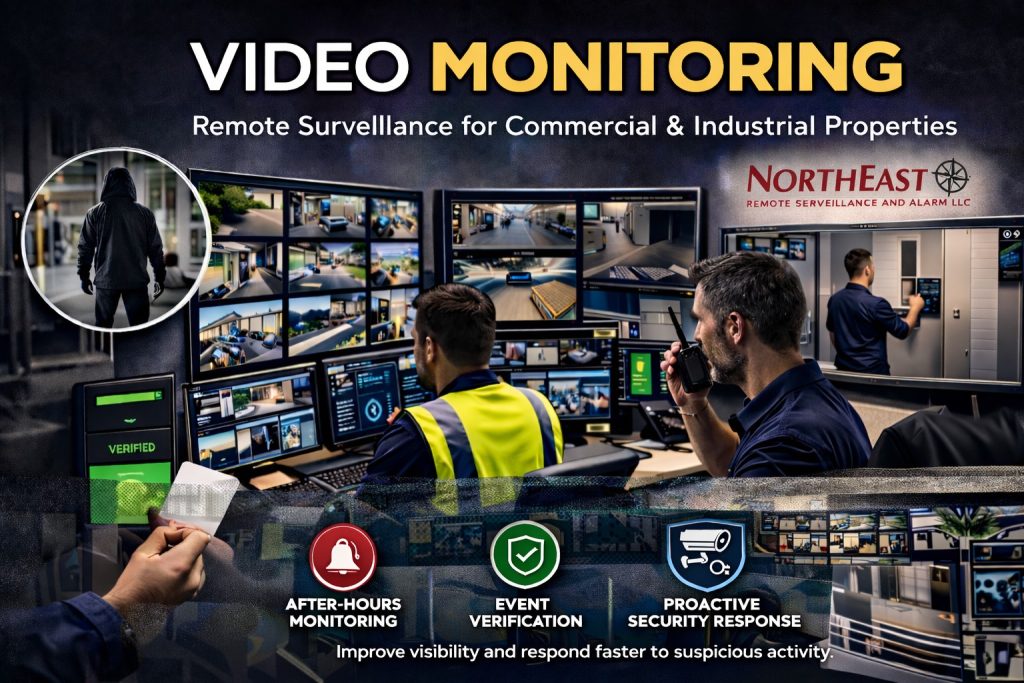
What Video Monitoring Means
Video monitoring uses cameras and connected monitoring workflows to help businesses watch for security events, verify activity, review incidents, and improve awareness across the property.
That may include:
- live remote viewing
- after-hours monitoring
- alarm-linked video verification
- perimeter activity review
- entry and exit visibility
- suspicious activity assessment
- faster review of recorded events
- better documentation after incidents
Instead of relying only on recorded footage after something happens, video monitoring helps businesses improve visibility while events are happening or soon after they occur.
Why Businesses Use Video Monitoring
Many properties already have cameras, but cameras alone do not always create real awareness.
A business may still struggle to answer questions like:
- What happened at the entrance after hours?
- Was that person authorized to be there?
- Did anyone approach the loading dock overnight?
- Was the gate event routine or unusual?
- Did a contractor or vendor enter the correct area?
- What happened before and after the alarm event?
Video monitoring helps close that gap by making camera activity more useful for real security decisions.
That can help businesses:
- verify alarm events faster
- reduce uncertainty around suspicious activity
- improve response to after-hours movement
- document incidents more clearly
- support internal investigations
- strengthen visibility across larger properties
- reduce blind spots in daily security management
Built for Commercial and Industrial Properties
Video monitoring is especially useful in environments with larger footprints, multiple access points, after-hours exposure, valuable inventory, or operational complexity.
That includes:
- office buildings and multi-tenant properties
- warehouses and distribution centers
- manufacturing and industrial facilities
- retail and mixed-use commercial sites
- healthcare and institutional properties
- schools and municipal buildings
- construction and infrastructure sites
- multi-building commercial campuses
These environments often need more than passive recording. They need visibility that supports real-time awareness and better follow-up when something happens.
Video Monitoring at Entrances, Perimeters, and Restricted Areas
Some parts of a property matter more than others. Video monitoring is most effective when it is focused on the places where security problems are most likely to start.
That may include:
- main entrances
- employee entrances
- rear and side doors
- loading docks
- shipping and receiving zones
- gates and yard access points
- parking areas
- restricted interior rooms
- inventory or storage areas
- perimeter approaches
The goal is not to watch everything equally. The goal is to improve awareness where risk is highest.
After-Hours Monitoring and Event Verification
One of the biggest strengths of video monitoring is after-hours visibility.
When staffing is low or the property is closed, businesses often need a better way to verify:
- unauthorized entry
- suspicious loitering
- gate activity
- parking lot movement
- dock activity
- perimeter breaches
- contractor access
- alarm events
Video monitoring helps businesses review these events with more context instead of relying on guesswork or incomplete reports.
Video Monitoring and Alarm Integration
Video monitoring becomes even more effective when it is tied to alarm activity.
When an alarm event occurs, video can help verify what actually caused it. That can improve response, reduce uncertainty, and create better documentation around the incident.
That may include:
- intrusion alarm verification
- after-hours motion event review
- perimeter breach assessment
- door event review
- suspicious activity confirmation
- stronger information for response decisions
For alarm-layer support, see [Commercial Alarm Systems].
Video Monitoring and Access Control Integration
Video monitoring also works well alongside access control.
When cameras and door activity are tied together, businesses can verify:
- who approached the door
- whether a credential was used
- whether access matched the expected user
- what happened before or after the door event
- whether the opening was forced or held open
That added visibility helps improve accountability and makes access-related incidents easier to review.
For deeper entry-management planning, see [Commercial Access Control] and [Access Control System].
Better Investigations and Better Documentation
A major advantage of video monitoring is better incident review.
Instead of trying to reconstruct an event from partial reports, businesses can use monitored video workflows to support:
- theft investigations
- property damage review
- visitor and contractor accountability
- employee incident review
- access disputes
- after-hours event verification
- safety and liability documentation
This can save time, improve clarity, and help management respond with better information.
Scalable for Single Sites and Multi-Site Properties
Video monitoring can support a single building, but it is also valuable for multi-site operations that need more consistent visibility across several properties.
A scalable monitoring strategy can help businesses:
- manage multiple buildings more consistently
- review incidents across locations
- standardize monitoring around key risk areas
- improve oversight for growing operations
- expand coverage without rebuilding the entire system
That makes video monitoring especially useful for regional businesses, warehouse operators, commercial property groups, and organizations with more than one location.
Installation, Upgrades, and Monitoring Strategy
Some businesses need a new monitoring-ready camera system. Others already have cameras in place but need stronger coverage, better camera placement, improved visibility, or better integration with alarm and access systems.
Northeast Remote Surveillance and Alarm, LLC provides support for:
- new video monitoring system installation
- surveillance camera upgrades
- improved coverage planning
- alarm and access control integration
- expansion for additional areas or buildings
- modernization of older camera systems
- long-term service and support
The goal is to make video more useful, not just increase the number of cameras on the property.
Why Businesses Choose Northeast Remote Surveillance and Alarm, LLC
Businesses choose Northeast Remote Surveillance and Alarm, LLC because video monitoring is treated like a real commercial and industrial security function, not just a camera add-on.
That means the focus stays on:
- practical camera placement
- meaningful visibility around high-risk areas
- stronger event verification
- clean integration with alarms and access control
- scalable planning for future growth
- long-term reliability and serviceability
We build monitoring strategies around how the property actually operates so businesses get better visibility, better documentation, and stronger day-to-day security awareness.
Schedule a Video Monitoring Review
If your business or facility needs better after-hours visibility, stronger event verification, cleaner alarm review, or more proactive security awareness, Northeast Remote Surveillance and Alarm, LLC can help.
Call 1-888-344-3846 to discuss your project or visit [Contact Us].
Frequently Asked Questions
What is video monitoring?
Video monitoring uses camera systems and connected review or monitoring workflows to improve visibility, verify security events, and help businesses respond with better information.
Is video monitoring different from having cameras installed?
Yes. Cameras record activity, but video monitoring makes that activity more useful by improving awareness, event review, and verification.
Can video monitoring help after hours?
Yes. After-hours monitoring is one of the biggest advantages because it helps verify suspicious activity, alarms, dock movement, gate events, and unauthorized entry when staffing is limited.
Can video monitoring work with alarm systems?
Yes. Video monitoring often works well with alarms because it helps verify intrusion events and provides better context around what caused the alert.
Can video monitoring work with access control?
Yes. Video monitoring can support access control by helping verify door activity, credential use, and restricted-area events.
Is video monitoring useful for warehouses and industrial properties?
Yes. Warehouses, industrial sites, and larger commercial properties often benefit the most because they have more perimeter exposure, more after-hours risk, and more areas that need visibility.