Business Door Access, Credential Management, and Entry Control for Commercial Properties
Commercial access control is not just about replacing keys. It is about giving businesses a better way to control entry, manage users, protect restricted areas, document access activity, and support day-to-day operations across commercial properties.
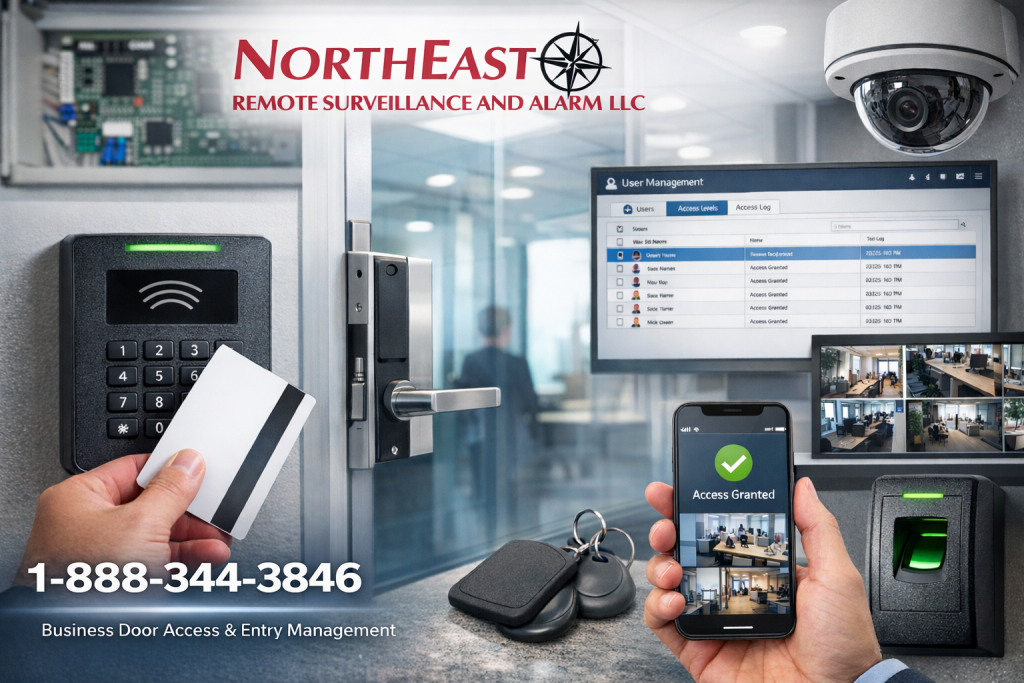
Northeast Remote Surveillance and Alarm, LLC designs and installs commercial access control systems for office buildings, multi-tenant properties, healthcare environments, schools, retail properties, mixed-use buildings, and other commercial facilities that need stronger control over who can enter, where they can go, and when they are allowed access.
For a broader overview of platform architecture, permissions, controllers, and long-term system design, see [Access Control System].
What Commercial Access Control Means
A commercial access control system gives a business structured control over entry points instead of relying on unmanaged keys, copied keys, or inconsistent door policies.
That matters because most commercial properties do not have just one front door and one lock problem. They often need to manage:
- employee entrances
- tenant suites
- shared corridors
- reception-controlled entry
- records rooms
- IT and telecom rooms
- storage areas
- after-hours access
- vendor and contractor access
- common-area permissions
- restricted interior offices or departments
In commercial environments, access control should make the property easier to manage, not harder. A good system helps define who belongs where, reduces confusion, speeds up credential changes, and gives property managers or administrators better visibility into access activity.
If your project is centered specifically on office buildings, medical suites, common areas, or multi-tenant layouts, see [Commercial Building Access Control Systems].
Why Businesses Move Beyond Keys
Traditional keys create management problems long before they create obvious security failures. A lost key, an unreturned key, a copied key, or an old master key set can turn into an ongoing liability. In many commercial buildings, keys also create operational friction because there is no easy way to limit access by schedule, revoke privileges instantly, or see who accessed a specific door.
Commercial access control helps businesses move from unmanaged entry to controlled permissions.
That can include:
- role-based access by employee, department, or tenant
- scheduled access by shift, day, or holiday
- instant credential deactivation when staffing changes occur
- audit trails for investigations and accountability
- temporary access for visitors, vendors, and contractors
- better control over shared areas and sensitive rooms
- cleaner management for multi-suite or multi-department properties
In practical terms, that means fewer workarounds, fewer key-related headaches, and better operational control over the property.
Credentials, Users, and Daily Management
One of the biggest advantages of commercial access control is that businesses can manage entry through credentials instead of depending entirely on physical keys.
Depending on the building and the application, that may include:
- keycards
- key fobs
- PIN credentials
- mobile credentials
- biometric factors where appropriate
The right credential approach depends on how the property operates. Some businesses need simple employee entry. Some need tenant-by-tenant control. Some need temporary contractor access. Others need stronger protection for finance rooms, network rooms, records storage, or executive areas.
Just as important, credential management should be practical. Businesses need a system that lets them add users, remove users, assign schedules, review events, and update permissions without making routine administration feel like a technical project.
For a deeper look at badges, mobile credentials, PINs, and identity strategy, see [Access Control Credentials].
Doors, Openings, and Real-World Commercial Conditions
Commercial access control is only as strong as the opening it protects. The reader, software, and credentials matter, but so do the actual doors, frames, hardware conditions, traffic levels, and code requirements.
That is why commercial access control should be designed around the real opening, not just around a software demo or a generic parts list.
Depending on the property, that may involve:
- electric strikes
- maglocks where appropriate
- panic hardware
- request-to-exit devices
- controlled interior doors
- vestibule or reception-area control
- suite entry hardware
- common-area or shared-door management
A high-traffic employee entrance does not behave like a low-use records room. A tenant suite entry does not behave like a lobby door. A medical office opening does not behave like a back-office storage room. Commercial access control works best when the hardware strategy matches the actual way the building is used.
For opening-specific planning and hardware strategy, see [Commercial Door Access Control Systems].
Commercial Access Control for Different Property Types
Commercial access control is valuable across a wide range of non-residential properties, but the use case changes depending on the building.
Office buildings often need better control over staff entrances, tenant suites, records rooms, shared corridors, reception-controlled entry, and after-hours access.
Multi-tenant properties often need cleaner separation between tenant areas, shared spaces, building management functions, and service access.
Healthcare offices may need stronger control over staff-only areas, records, medications, restricted rooms, and visitor movement.
Educational and institutional properties may need scheduled unlocking, staff permissions, restricted offices, and controlled circulation.
Retail and mixed-use properties may need employee-only areas, stockroom protection, manager access, service-entry control, and better handling of vendors and after-hours entry.
Some businesses also operate warehouse, staging, or support areas inside a broader commercial footprint. When the project leans more heavily into warehouse operations, dock-adjacent spaces, or larger logistics workflows, see [INTERNAL LINK: Warehouse Security Systems].
Integration Makes Commercial Access Control Stronger
Commercial access control becomes much more useful when it is part of a broader security strategy instead of a standalone door product.
When integrated properly, access control can work alongside video surveillance and alarms to give businesses better visibility into what happened around an event, not just whether a credential was accepted or denied.
That can help with:
- forced-door review
- propped-door incidents
- after-hours entry events
- visitor and contractor verification
- tenant or employee investigations
- common-area incident review
- faster response to unusual activity
For businesses that want stronger event review and centralized visibility, see [INTERNAL LINK: Video Surveillance and Access Control Unified Security Systems].
Commercial Access Control Should Be Built to Scale
A commercial property rarely stays static forever. Tenants change. Departments move. Businesses grow. Suites are reconfigured. New doors need to be added. Shared spaces change hands. Compliance expectations evolve.
That is why commercial access control should not be designed as a one-time fix for one door. It should be designed as a system that can expand with the property and continue to make sense as the building changes.
A scalable commercial access control system should support:
- additional doors
- added users or tenants
- changed schedules and permissions
- future suite buildouts
- additional credential types
- integrations with video or alarms
- multi-building expansion where needed
For a more detailed look at deployment options such as on-premises, cloud-managed, and hybrid models, see [Access Control System Types for Commercial Security].
Installation, Upgrades, and Existing-System Takeovers
Not every commercial access control project starts from scratch. Many businesses already have a partial system in place, but it may be outdated, hard to manage, poorly installed, unsupported, or no longer aligned with how the property operates.
In those cases, the next step may be:
- upgrading readers or credentials
- replacing aging controllers
- correcting door hardware issues
- improving software usability
- adding doors to an existing system
- integrating access control with alarms or video
- taking over and stabilizing an older system
Commercial properties often need practical modernization, not just a full rip-and-replace recommendation. A good assessment helps determine what should be kept, what should be corrected, and what should be replaced.
For project scoping, fieldwork, and installation planning, see [Access Control Systems Installation].
Accountability, Policy, and Compliance
Commercial access control is not just a convenience feature. It also supports accountability.
When businesses know who entered a room, when they entered, and what credential was used, they gain more than a locked door. They gain documentation. That can help with internal policy enforcement, tenant disputes, HR reviews, sensitive-room protection, and investigations after an incident.
In some environments, access control also supports broader safety and compliance goals by helping restrict sensitive rooms, enforce access policies, and produce usable logs during reviews or audits.
For the compliance side of the topic, see [How Access Control Supports Compliance with HIPAA, OSHA, and Internal Policy Requirements].
Why Businesses Choose Northeast Remote Surveillance and Alarm, LLC
Businesses choose Northeast Remote Surveillance and Alarm, LLC because commercial access control is treated like real building infrastructure, not a consumer gadget install.
That means the focus stays on:
- commercial-grade hardware
- code-aware opening design
- practical credential management
- clean installations
- scalable system planning
- real integration capability
- long-term reliability and serviceability
We design systems around the way a commercial property actually operates so the result is easier to manage, more reliable, and better aligned with the real needs of the building.
Schedule a Commercial Access Control Review
If your office building, multi-tenant property, medical office, school, retail property, or mixed-use facility needs better control over doors, credentials, shared spaces, or restricted areas, Northeast Remote Surveillance and Alarm, LLC can help.
Call 1-888-344-3846 to discuss your project or visit [Contact Us].
Frequently Asked Questions
What is commercial access control?
Commercial access control is a system that manages who can enter a business property, suite, room, or restricted area and when that access is allowed. It replaces or supplements traditional keys with managed credentials, schedules, audit trails, and centralized control.
Can commercial access control be added to existing doors?
Yes. Many commercial access control projects are retrofits. The right approach depends on the existing opening, frame, hardware, traffic level, and code requirements.
What credential types are common in commercial buildings?
Most commercial properties use a mix of cards, fobs, mobile credentials, PIN entry, and sometimes biometric factors depending on the building and the risk level of the area being secured.
Is commercial access control only for large businesses?
No. Smaller office buildings, medical offices, retail properties, and mixed-use buildings often benefit significantly from access control, especially when they need better after-hours control, staff-only areas, or cleaner handling of credentials.
Can one system manage multiple suites or buildings?
Yes. Many commercial access control systems can manage multiple tenant suites, departments, or buildings from one platform, which is especially useful for larger properties or growing operations.
Can commercial access control integrate with cameras and alarms?
Yes. Integration with video surveillance and alarms can improve event review, support incident documentation, and strengthen overall building security.
Is commercial access control useful for tenant turnover or staffing changes?
Yes. One of the biggest operational benefits is the ability to change or revoke access quickly without relying on rekeying or collecting every physical key.
Exact internal link map
- Access Control System →
/our-services/access-control-system/ - Commercial Building Access Control Systems →
/commercial-building-access-control-systems/ - Access Control Credentials →
/access-control-credentials/ - Commercial Door Access Control Systems →
/commercial-door-access-control-systems/ - Warehouse Security Systems →
/our-services/warehouse-security-systems/ - Video Surveillance and Access Control Unified Security Systems →
/video-surveillance-and-access-control-unified-security-systems/ - Access Control System Types for Commercial Security →
/access-control-system-types/ - Access Control Systems Installation →
/access-control-systems-installation/ - How Access Control Supports Compliance with HIPAA, OSHA, and Internal Policy Requirements →
/access-control-supports-compliance/ - Contact Us →
/contact-us/