Intrusion Detection, Monitored Protection, and Business Alarm Systems for Commercial and Industrial Properties
A commercial alarm system does more than sound a siren.
For businesses, alarm systems help detect intrusion, verify unusual activity, improve after-hours protection, strengthen perimeter awareness, and support faster response when something is wrong. In commercial and industrial environments, a properly designed alarm system becomes part of a broader security strategy built around real property risk, not just one device on the wall.
Northeast Remote Surveillance and Alarm, LLC designs and installs commercial alarm systems for offices, warehouses, retail properties, healthcare environments, schools, municipal facilities, and industrial buildings that need stronger detection, better event awareness, and cleaner integration across the property. For monitoring-focused support, see [Video Monitoring]. For integrated surveillance and door-security planning, see [Video Surveillance and Access Control Unified Security Systems].
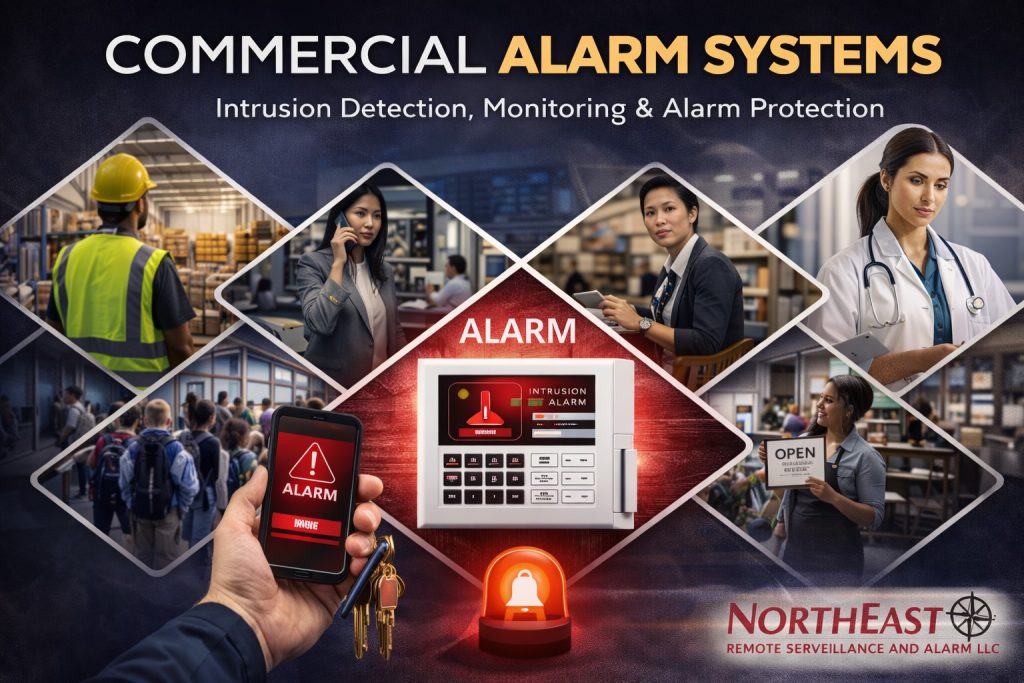
What a Commercial Alarm System Does
A commercial alarm system helps detect and communicate security events that may require attention.
That can include:
- unauthorized entry
- after-hours intrusion
- perimeter breaches
- suspicious interior movement
- door or window breaches
- restricted-area alarms
- environmental alerts depending on system design
- monitored alarm events tied to response workflows
Instead of relying only on locks or cameras, alarms help create active detection around the parts of the property where security issues often begin.
Why Businesses Use Commercial Alarm Systems
Many business properties need more than passive security.
Locks may slow entry. Cameras may record events. But alarm systems help identify when something is actually wrong and bring attention to the event sooner.
That helps businesses:
- improve after-hours protection
- detect intrusion faster
- strengthen perimeter awareness
- support faster verification and response
- reduce uncertainty around suspicious activity
- improve documentation after incidents
- add another layer to a broader commercial security plan
For many properties, alarm systems are the layer that turns security from observation into detection.
Built for Commercial and Industrial Environments
Commercial alarm systems are used across a wide range of properties, including:
- office buildings and multi-tenant spaces
- warehouses and distribution centers
- retail and mixed-use properties
- manufacturing and industrial facilities
- healthcare and medical environments
- schools and institutional buildings
- municipal and public-sector facilities
- storage, utility, and restricted-area spaces
Each environment creates different alarm needs depending on building layout, operating hours, public access, restricted zones, staffing patterns, and after-hours exposure.
Where Commercial Alarm Protection Matters Most
Alarm systems are most effective when they are designed around the actual risk points of the property.
That may include:
- main entrances
- rear and side doors
- shipping and receiving areas
- loading docks
- windows and vulnerable perimeter openings
- interior restricted rooms
- storage and inventory spaces
- offices with sensitive materials
- IT and telecom rooms
- gates, yards, and exterior support areas
The goal is not to place devices randomly. The goal is to detect intrusion and unusual activity where it matters most.
Intrusion Detection for Business Properties
Intrusion detection is one of the core functions of a commercial alarm system.
Depending on the application, that may include:
- door contacts
- window contacts
- motion detectors
- glass break detectors
- beam or perimeter devices
- interior area protection
- restricted-zone alarms
- scheduled arming and disarming logic
A well-designed intrusion system helps a business know when a space has been entered, breached, or moved through outside expected conditions.
Alarm Monitoring and Event Awareness
Alarm systems become more valuable when they are part of a monitored security workflow.
Monitoring can help businesses:
- identify alarm events faster
- verify activity more clearly
- respond to after-hours incidents with better information
- reduce uncertainty around what triggered the alarm
- support incident documentation
That is especially important in buildings that are lightly staffed after hours, have multiple access points, or need stronger coverage during nights, weekends, and holidays.
For remote visibility and monitored event review, see [Video Monitoring].
Better Alarm Verification With Video
Alarm systems and video surveillance work better together.
When an alarm event occurs, businesses often need to answer one immediate question: what caused it?
Connecting alarm activity to video surveillance helps provide that context. Instead of responding to a signal alone, businesses can review what happened around the event and make better decisions faster.
That may help with:
- intrusion alarm verification
- after-hours motion events
- restricted-area breaches
- perimeter activity review
- dock and yard incidents
- suspicious movement around doors or gates
For integrated security planning, see [Video Surveillance and Access Control Unified Security Systems].
Better Alarm Awareness With Access Control
Alarm systems can also work alongside access control to strengthen building security.
That may help businesses understand:
- whether a door event was authorized
- whether an alarm matched a valid access event
- whether a restricted area was entered outside schedule rules
- whether an opening was forced or misused
- what happened before and after the alarm condition
This gives businesses better visibility around entrances, restricted rooms, and employee-only areas. For entry-management planning, see [Commercial Access Control] and [Access Control System].
Commercial Alarm Systems for Warehouses and Higher-Risk Properties
Warehouses, industrial buildings, and larger commercial sites often need more than basic intrusion detection.
These environments may need stronger protection around:
- loading docks
- side and rear doors
- shipping offices
- inventory areas
- yards and gates
- trailer and vehicle movement
- after-hours employee access
- restricted storage or support spaces
Because these properties often have larger footprints and more after-hours exposure, alarm systems work best when paired with cameras, controlled access, and stronger monitoring workflows.
For warehouse-focused protection, see [Warehouse Security Systems].
Scalable Alarm Protection for Growing Operations
A business rarely stays static forever. As the building changes, alarm coverage may need to change too.
A scalable commercial alarm strategy should support:
- added doors and spaces
- expanded interior protection
- new restricted areas
- added buildings or connected spaces
- stronger integration with surveillance and access control
- modernization of older devices or panels
- long-term serviceability
That matters for businesses planning future buildouts, facility growth, or broader integration with other commercial security systems.
New Systems, Upgrades, and Existing Alarm Takeovers
Some businesses need a fully new alarm system. Others already have a system in place but need better coverage, updated hardware, improved monitoring, or cleaner integration with newer security tools.
Northeast Remote Surveillance and Alarm, LLC provides support for:
- new commercial alarm system installation
- alarm panel and device upgrades
- coverage improvements
- system expansion
- integration with video surveillance and access control
- modernization of older alarm systems
- ongoing service and support
The goal is to build an alarm system that actually matches the way the property operates instead of leaving major risk areas underprotected.
Why Businesses Choose Northeast Remote Surveillance and Alarm, LLC
Businesses choose Northeast Remote Surveillance and Alarm, LLC because commercial alarm systems are treated like a real business-security layer, not just a basic signal device.
That means the focus stays on:
- practical risk-based system design
- better after-hours protection
- commercial-grade hardware
- cleaner alarm verification
- integration with cameras and access control
- scalable planning for future growth
- long-term reliability and serviceability
We design alarm systems around how the property actually functions so businesses get stronger detection, better event awareness, and a more complete commercial security strategy.
Schedule a Commercial Alarm System Review
If your business or facility needs stronger intrusion detection, better after-hours protection, cleaner alarm verification, or more complete commercial security coverage, Northeast Remote Surveillance and Alarm, LLC can help.
Call 1-888-344-3846 to discuss your project or visit [Contact Us].
Frequently Asked Questions
What is a commercial alarm system?
A commercial alarm system helps detect intrusion, unauthorized entry, suspicious movement, and other security events that may require attention at a business property.
Are commercial alarm systems only for after-hours protection?
No. After-hours protection is important, but alarm systems also help protect restricted areas, perimeter openings, and sensitive spaces during normal operations.
Can commercial alarm systems work with cameras?
Yes. Alarm systems often work best with video surveillance because video helps verify what caused the event and improves response decisions.
Can commercial alarm systems work with access control?
Yes. Alarm systems can support access control by helping verify door-related events, restricted-area activity, and unauthorized entry outside approved schedules.
Are alarm systems useful for warehouses and industrial buildings?
Yes. Warehouses and industrial facilities often benefit greatly from alarm systems because they have larger footprints, more entry points, and more after-hours exposure.
Can an older commercial alarm system be upgraded?
Yes. Many older alarm systems can be upgraded, expanded, or integrated with newer security systems depending on the existing hardware and overall system condition.